What Ventilation Setups Work Best During Spraying and Refinishing?
How do I vent fumes safely in an apartment or condo with no exterior windows?
What type of exhaust fan or turbine system should I use for bathroom refinishing?
Ventilation & Containment Systems
What gun cleaning solutions protect seals?
Professional HVLP spray systems with appropriate nozzle sizes can atomize thicker refinishing coatings effectively.
Not all cleaning solutions are safe for spray gun components.
Choose cleaning solutions that:
- Do not degrade seals
- Do not corrode internal passages
- Remove coating residue effectively
- Use nylon brushes and Zen-Strip Liquid for monthly thorough cleanings.
Regular maintenance prevents costly equipment replacement.
Do I need a carbon filter or just a HEPA filter for refinishing fumes?
HEPA filtration captures particulate — overspray droplets and solid particles — but does not capture VOC vapors in their gaseous phase. For odor control and vapor-phase VOC reduction, activated carbon filtration is required. Most refinishing situations that involve vapor hazard management — occupied buildings, healthcare facilities, anywhere odor control matters — need activated carbon or activated charcoal filtration in addition to particulate filtration. For jobs where the primary concern is overspray containment rather than vapor capture, HEPA alone addresses the particulate issue, with exhaust handling vapor dispersion.
This is a real concern, particularly in commercial and multi-unit buildings where central fire suppression systems may be more sensitive than residential smoke detectors. Before starting any job in a building with a central alarm system, notify building management and, if appropriate, the fire suppression monitoring company. Request a temporary alarm deactivation in the affected zone during the spray and initial cure window — most building managers with experience in renovation work know this protocol. Cover smoke detectors in the immediate work area with plastic sheeting, but only after notifying the relevant parties, and uncover them promptly when the spray session is complete. Never permanently disable fire detection systems.
How do I reduce odors when working in schools, hospitals, or occupied homes?
What's the best way to seal the work area to maintain airflow direction?
Every refinishing contractor eventually develops a ventilation routine. Some figure it out through trial and error — a job where the coating flashed too fast, a space that fogged up mid-spray, or a client complaining about odor that lingered in the adjacent room. Others inherit a setup from whoever trained them and run it without much thought about whether it's actually optimal.
The problem with treating ventilation as an afterthought is that it affects more than safety. Airflow — or the lack of it — directly influences how your coating lays down, how quickly it cures, and whether the finished surface looks the way it should. Get it right and you're working in a controlled environment that helps you do your best work. Get it wrong and you're fighting your own spray pattern, your dry times, and your client's concerns about what's happening in the rest of their home.
This guide covers the full range of ventilation approaches for professional refinishing work: the equipment, the setups, how to adapt to different job environments, and the connection between airflow and coating performance.
Why Ventilation Matters Beyond the Obvious
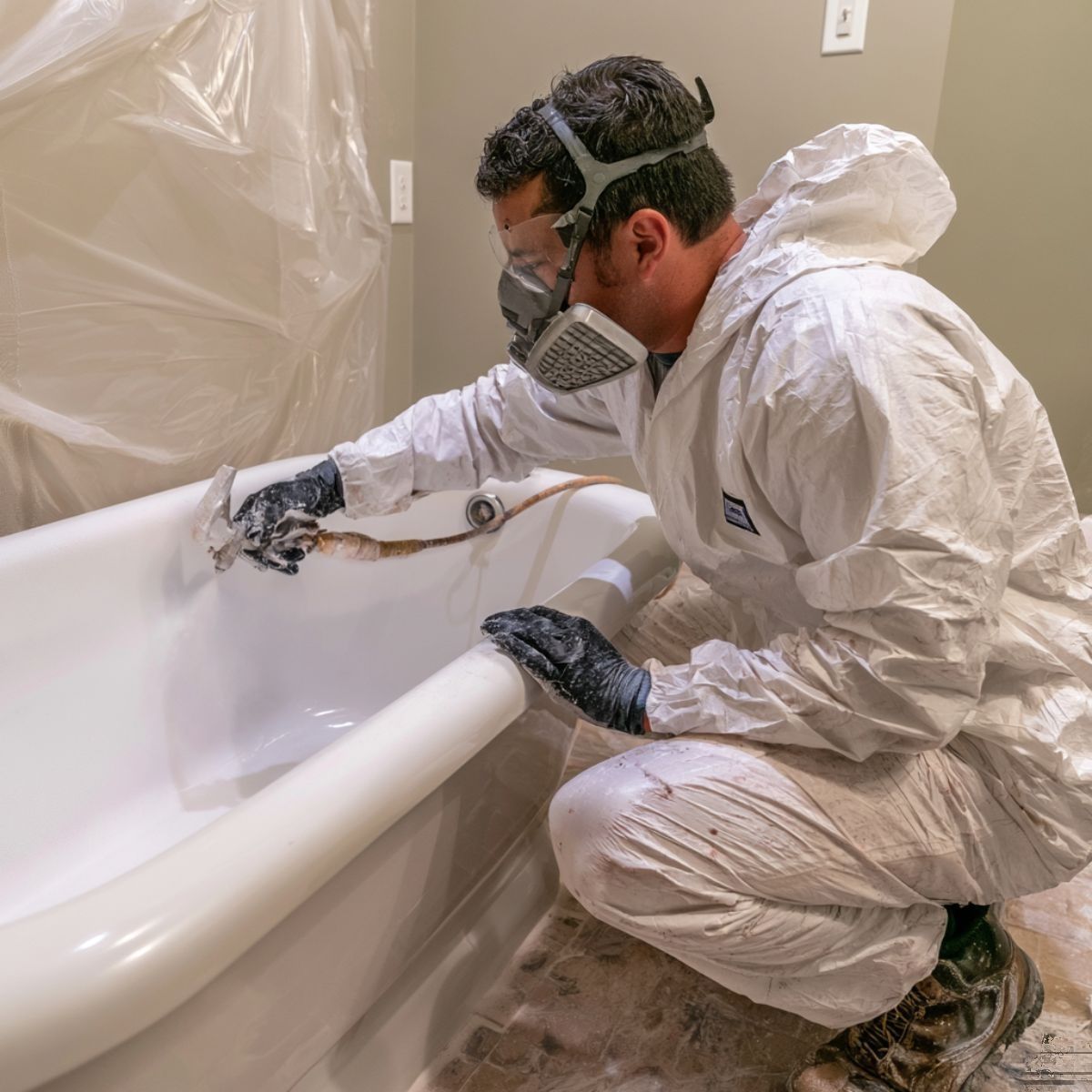
The safety case for ventilation in refinishing is well established. Professional refinishing coatings — two-component urethanes, epoxy primers, and even water-based systems — produce airborne VOCs and fine particulate during spray application. Without adequate exhaust, those particles and vapors accumulate in the work area faster than they dissipate. Even with proper respiratory protection, working in a saturated environment creates unnecessary chemical exposure and represents a situation where something unexpected — a respirator fit issue, a quick mask-off moment, an uncovered face — can become a real problem.
But beyond the safety argument, there's a practical one: poor ventilation directly degrades your work.
When vapors and atomized particles aren't moving out of the space, they stay suspended in the air around your spray zone. Those particles eventually settle — on your wet coating. This is one of the primary causes of texture, dry spray contamination, and inconsistent gloss in a finished refinishing job. Airflow that moves particles away from the surface and out of the space keeps the coating environment cleaner and produces better-looking work.
Ventilation also accelerates dry time by keeping fresh air moving across the coating surface, which helps solvents and water vapor flash off faster. On a job with multiple coats — two coats of primer and two to three topcoat passes — shaving 10 minutes off each recoat window adds up across the day. Contractors who work with good ventilation consistently turn jobs faster than those who don't.
For a full breakdown of how environmental conditions including airflow affect recoat windows and cure times for Zen-Tek products, see the
Professional Refinisher's Equipment Cheatsheet on the Zen-Tek blog.
Understanding Airflow Direction: The Principle Behind Every Setup
Before getting into specific setups, it's worth understanding the principle that all effective ventilation is built around: directional airflow.
The goal is to create a consistent movement of air through the work space — on one side, across the spray zone, and out the other. This does two things simultaneously. It sweeps overspray particles and vapors away from both the worker and the freshly coated surface, and it brings cleaner air in to replace what's been exhausted.
What you're trying to avoid is turbulent, recirculating airflow — fans positioned opposite each other, or exhaust without adequate makeup air — that moves particles around the space without actually removing them. That kind of airflow can deposit contamination on a fresh surface as easily as no ventilation at all.
The practical application: one exhaust point pulling air out, one or more makeup air pathways letting clean air in, and the spray zone positioned between them so the airflow moves through your work rather than around it.
Ventilation Setup Options for Refinishing Contractors
The Exhaust Fan and Window Setup
For most standard bathroom refinishing jobs, a portable exhaust fan positioned at the bathroom window is the workhorse setup. A box fan or dedicated refinishing exhaust fan — rated for the CFM (cubic feet per minute) appropriate to the space — sits in or just inside the window opening with airflow directed out. The bathroom door is cracked to provide makeup air from the rest of the structure, creating a draw through the space from door to window.
The key variable is CFM. A 5x8 bathroom needs adequate air exchange to keep the vapor concentration manageable during spray application. Most professional refinishing exhaust fans used in this application are in the 200–500 CFM range. Household box fans often don't move enough air to be effective — a dedicated variable-speed exhaust fan with a known CFM rating gives you control that a hardware store box fan doesn't.
Practical considerations:
- Position the exhaust fan at the far end of the bathroom from the door so airflow moves through the entire space
- Seal gaps around the fan with masking plastic to prevent air from bypassing the fan and recirculating
- In bathrooms with no exterior window, this setup requires adapting to duct out through an alternative path — more on that below
- Consider the direction of airflow relative to your spray path: you want vapor moving away from you and the surface, not across your face
Ducted Exhaust Through Doorways and Hallways
In apartments, condos, and interior bathrooms with no exterior window, the window-fan setup isn't available. The alternative is a ducted exhaust system — a fan connected to flexible ducting that runs from the bathroom through a doorway, down a hallway, and to an exterior door or window elsewhere in the unit.
This requires more setup time and equipment, but it's the right solution for enclosed spaces. Flexible duct in the 6–8 inch diameter range is standard for refinishing exhaust applications. The fan pulls from the work area through the duct and exhausts outside, while makeup air enters around the duct or through a cracked door.
The longer the duct runs, the more resistance the fan works against, and the more CFM capacity you need to maintain effective airflow. For long runs — 20 feet or more — step up your fan capacity accordingly. Collapses or sharp bends in the duct significantly reduce airflow efficiency; run the duct as straight as possible with gradual bends where turns are unavoidable.
How far the exhaust terminus should extend outdoors depends on the situation. As a general principle, the exhaust point should be far enough from any windows, doors, or HVAC intakes on the exterior of the building that fumes don't re-enter the structure. In most cases, exhausting through an exterior door to open air is sufficient. In multi-unit buildings, be thoughtful about where fumes are exiting relative to neighboring units — what leaves your exhaust point becomes your neighbor's air quality problem if the setup isn't planned well.
Negative Air Machines
A negative air machine — a powered filtration unit that creates negative pressure in the work area — is the commercial-grade step up from a basic fan setup. These units draw air through a filter (typically a combination of pre-filter and HEPA filter) and exhaust it either out of the space or recirculate it cleaned. In refinishing applications, negative air machines are most commonly used for exhaust, not recirculation — the filter captures particulate, and the unit creates the negative pressure environment that keeps contaminated air from migrating out of the work zone into the rest of the building.
Negative air machines shine in jobs where containment is as important as ventilation: healthcare facilities, schools, occupied multi-unit buildings, and any environment where the client or facility manager has specific air quality requirements. A sealed bathroom under negative pressure means that any air leakage at the door moves into the work area rather than out of it, keeping odors and particles contained.
The filter consideration matters here. For refinishing applications with solvent-borne coatings, a HEPA filter alone doesn't capture VOC vapors — it captures particles. Carbon pre-filters or activated charcoal filtration handles vapor-phase VOCs. If odor control in adjacent spaces is the goal, you need a unit with activated carbon filtration, not just HEPA.
Portable Spray Booths
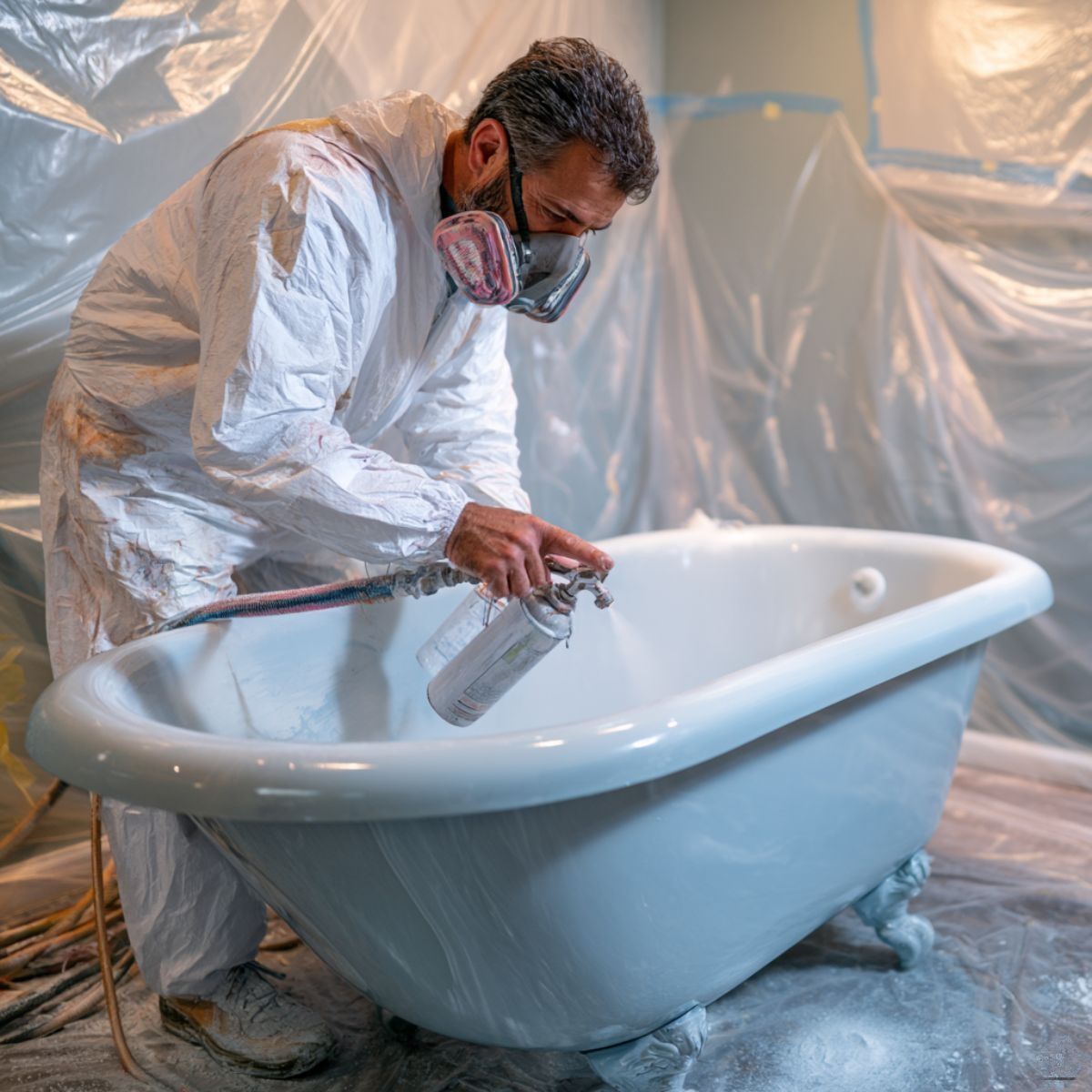
For fixtures that can be removed from the bathroom — possibly a farmhouse sink or a standalone clawfoot tub — a portable spray booth provides an on-site or off-site controlled spray environment that's simply not achievable in a bathroom.
Portable spray booths are filtered enclosures with their own exhaust systems that capture overspray, filter airflow, and provide a consistent application environment regardless of what the job site conditions look like. The investment is significant compared to a fan and duct setup, but for contractors who regularly do work that can be removed and sprayed separately — particularly cabinet refinishing — the quality and consistency improvement is real.
When spraying cabinet doors with a product like Cabinext, Zen-Tek's acrylic topcoat engineered for cabinet and countertop refinishing, spraying flat in a controlled booth environment produces dramatically more consistent results than spraying in place inside a kitchen with whatever ventilation is available. The booth also eliminates the masking burden of protecting the surrounding space.
For fixtures that must be refinished in place — most tubs and tile walls — the booth isn't an option, and the fan-and-duct or negative air machine setups above apply.
Step 5: Final Wipe-Down Before Primer
After sanding or etching, do a final solvent wipe to remove any remaining contaminants, fingerprints, or dust. This step is often skipped in the interest of time. It shouldn't be. Anything on the surface when the primer goes on is bonded under the finish permanently.
Use an appropriate solvent wipe — follow the recommendation in your primer's technical data sheet. Wipe in one direction with a clean cloth; don't scrub back and forth which can redistribute contamination. Use a fresh cloth for the final pass.
Avoid touching the surface with bare hands after the final wipe. Skin oils contaminate surfaces immediately and are invisible until a fisheye or adhesion void appears in the primer coat.
Step 6: Apply Primer
The relationship between ventilation and coating quality deserves more attention than it usually gets in field discussions. A few specific connections:
Orange peel and dry spray: Both are caused or worsened by inadequate airflow. When vapors accumulate around the spray zone, the coating's flash dynamics change — solvents can't leave the film at the rate they need to for proper leveling, and the coating surface begins to set before it has leveled fully. Airflow that keeps the spray environment clean and moving prevents this. Zen-Tek's post on what causes orange peel and how to prevent it covers this in depth, including the role of environmental conditions in finish texture.
Recoat windows: Adequate airflow shortens recoat windows by accelerating solvent flash-off and surface set. On a job with four or five coating passes total, this is a material impact on how long the job takes. Contractors who run effective ventilation consistently hit the shorter end of recoat windows; those without adequate airflow often find themselves waiting longer than expected between coats.
Contamination: Airborne particles that aren't being exhausted eventually land somewhere. In an inadequately ventilated space, some of that overspray finds the freshly coated surface. Even fine particles that don't read as obvious debris create a texture in the finished film that shouldn't be there. Effective exhaust moves those particles out of the space rather than letting them settle.
Ventilation Considerations by Coating Type
Not all Zen-Tek coatings carry the same ventilation requirements, and understanding the differences helps contractors make better decisions about both product selection and job-site setup.
Solvent-borne two-component coatings — including Prime-X epoxy primer and Synergy polyurethane acrylic topcoat — require robust ventilation during application and through the initial cure window. These products generate significant solvent vapor during spray, and adequate exhaust is a non-negotiable safety requirement, not just a quality consideration.
Zen-Tek's iso-free Zenix 2K topcoat eliminates the isocyanate hazard associated with conventional urethane hardeners, which removes the most severe respiratory sensitization risk from the spray environment. Ventilation is still required during Zenix application — it's not a zero-emissions product — but the hazard profile is meaningfully different from an isocyanate-containing system.
For water-based products —
WTR-Prime and
WTR-Tek — the VOC load during application is substantially lower than solvent-borne systems, and the odor profile is significantly reduced. Ventilation is still recommended for both finish quality and occupant comfort, but the required airflow is less critical from a chemical exposure standpoint. For jobs in occupied homes, schools, or healthcare facilities where even the smell of a solvent-borne product would be problematic, water-based systems combined with a basic exhaust fan often satisfy both the safety requirement and the client's expectations. For a full look at how Zen-Tek's water-based products serve safety-conscious clients, see the post on
low-VOC refinishing for hospitals and schools.
Sealing the Work Area
Effective ventilation and containment go together. An exhaust fan in the window doesn't work as designed if the bathroom door is wide open, overspray and vapors can flow freely into the living space, and the makeup air is coming from six different gaps rather than a single controlled point.
Before spraying, seal the work area:
- Tape masking plastic across the bottom of the bathroom door, leaving a controlled gap or using a pre-cut opening to manage makeup air entry
- Seal any HVAC supply or return vents in the bathroom — you don't want coating vapors entering the duct system and distributing through the building
- Seal gaps around the exhaust fan at the window to force all exhaust air through the fan rather than allowing bypass
- If the bathroom has a ventilation fan integrated into the ceiling, consider whether running it as supplemental exhaust is appropriate or whether it routes into a shared building duct that could carry vapors to other units
Protecting Adjacent Spaces in Multi-Unit Buildings
In apartment buildings, condos, and multi-unit commercial properties, the concern isn't just the work area — it's what happens in the adjacent spaces. Solvent vapors travel through gaps under doors, through shared ductwork, and even through wall penetrations in older construction. A sealed work area with negative pressure is the most reliable approach in these environments because it ensures any air movement at room boundaries flows in rather than out.
Communicate with building management before jobs in occupied multi-unit buildings. Know where the HVAC system intakes are located and keep exhaust points well clear of them. Early morning work hours, before heavy building occupancy, reduce the number of people affected by any odor that does escape. And where client requirements make it necessary, specifying water-based coatings like
WTR-Tek and WTR-Prime over solvent-borne alternatives reduces the vapor load to a level that most occupied building environments can handle.
What OSHA Says About Refinishing Ventilation
OSHA's standards for spray finishing operations (29 CFR 1910.94 and related standards) establish requirements for ventilated spray areas, including minimum air velocity requirements for spray zones and specific provisions for different coating chemistries. These standards apply to professional spray operations, which includes refinishing work done as a business.
The general principle OSHA establishes is that spray finishing should be conducted in areas with mechanical ventilation capable of maintaining airborne concentrations of flammable vapors below the lower explosive limit and hazardous substances below permissible exposure limits. This isn't a precise prescription for a bathroom fan setup — the standards were written primarily for industrial spray facilities — but the underlying requirement to provide adequate mechanical ventilation during spray finishing applies to field work as well.
State and local regulations may impose additional requirements, particularly in jurisdictions with stricter indoor air quality or VOC emission rules. If you're working in a commercial facility or under a contract with regulatory compliance requirements, verify that your ventilation setup meets the applicable standards for that job type. When in doubt about what's required for a specific situation, consult with a safety professional or your local OSHA compliance office rather than relying solely on field judgment.
Frequently Asked Questions About Refinishing Ventilation
What's the best ventilation setup for refinishing a tub in a small bathroom?
A dedicated portable exhaust fan positioned at the bathroom window, rated for at least 200–300 CFM, with makeup air entering through a controlled gap at the bathroom door. The fan should be sealed into the window opening to prevent bypass airflow. Position yourself and the spray zone between the makeup air entry point and the exhaust so vapor and overspray move away from you and out of the space. For solvent-borne coatings, this setup combined with appropriate respiratory protection is the baseline for safe spray work in a small enclosed bathroom.
Do I need a fume extractor or just a box fan and window?
A dedicated fume extractor — or at minimum a variable-speed exhaust fan with a known CFM rating — is a better tool than a standard box fan. Box fans sold at hardware stores are typically rated for moving air in open spaces, not for the resistance of a window installation, and their actual output in that configuration is often well below the labeled CFM. A dedicated refinishing exhaust fan or HVAC inline fan gives you reliable, measurable airflow that a hardware store fan doesn't. For jobs where odor containment is also a concern, a fume extractor with activated carbon filtration handles vapor-phase VOCs that a plain fan exhausts into the adjacent outdoor space.
How do I vent fumes safely in an apartment or condo with no exterior windows?
Use a ducted exhaust setup — a fan connected to flexible ducting that runs from the bathroom through the unit to an exterior door or window. Seal the work area at the bathroom door with plastic sheeting and a controlled makeup air opening. Keep duct runs as short and straight as possible to maintain airflow efficiency. In multi-unit buildings, consider whether a negative air machine is more appropriate than open exhaust — it creates negative pressure in the work area that prevents vapors from migrating into the building while filtering the exhausted air. For environments where any solvent odor is problematic, water-based coatings like WTR-Tek and WTR-Prime from Zen-Tek Coatings significantly reduce the vapor load compared to solvent-borne systems.
What type of exhaust fan or turbine system should I use for bathroom refinishing?
Variable-speed inline duct fans, rated at 300–500 CFM for standard bathroom spaces, are a practical and portable choice for most refinishing work. For higher-volume operations or jobs in larger spaces, turbine-style exhaust systems move more air and handle longer duct runs with less efficiency loss. The key specifications to match to your work are CFM capacity (matched to the volume of the space and the length of your duct run), duct diameter compatibility, and static pressure rating — how well the fan maintains airflow against resistance over distance. For longer runs, this last spec matters most. Turbine-style exhaust systems are particularly well suited to jobs where the exhaust point is far from the work area — an 8-inch turbine pulls 400–1,800 CFM, while a 12-inch turbine can move 400–2,600 CFM. That combination of high CFM and strong static pressure is what allows a turbine system to effectively move air 50 to 100 feet down a hallway, making them the right tool for large commercial spaces or interior units with no nearby exterior access. For a broader look at equipment selection in professional refinishing, the equipment cheatsheet on the Zen-Tek blog covers ventilation equipment alongside spray guns and prep tools.
Can I use a negative air machine to control overspray and odor?
Yes, and it's the preferred approach for jobs where containment is a priority. A negative air machine creates negative pressure in the work area, which means any air movement at boundaries flows into the space rather than out — effectively preventing overspray and odors from migrating into adjacent areas. For particulate capture, HEPA filtration handles overspray particles well. For vapor-phase odor control, the unit needs activated carbon filtration in addition to HEPA. Most professional negative air machines designed for remediation and construction work can be configured for both. They're a higher equipment cost than a fan-and-duct setup but the right tool for healthcare facilities, schools, and occupied multi-unit buildings.
What size ducting is ideal for venting refinishing fumes out of a bathroom?
Six-inch flexible duct is the minimum for most refinishing exhaust setups; 8-inch duct handles longer runs or higher-CFM fans without the airflow restriction that 6-inch creates at higher volumes. Use the largest diameter your fan is rated for and that the job site can accommodate. Avoid reducing the duct diameter from the fan outlet — any reduction creates back-pressure that drops your effective CFM. Keep the duct as straight as possible; each 90-degree bend is equivalent to adding several feet of straight duct in terms of flow resistance.
How far should the exhaust hose extend outdoors to avoid complaints or hazards?
The exhaust terminus needs to be far enough from any re-entry points — windows, doors, HVAC intakes, neighboring unit openings — that exhausted vapors don't re-enter the building or affect adjacent properties. In a single-family home, exhausting through an exterior door or window to open air is generally sufficient, with the exhaust pointed away from the building. In multi-unit buildings, think carefully about where the exhaust is going relative to neighboring units, and consider scheduling to work when wind conditions carry exhaust away from the building rather than along the facade. Activated carbon filtration on the exhaust reduces odor concentration at the terminus even before dispersion.
Should I use an intake fan to supply fresh air, or is exhaust-only sufficient?
Exhaust-only setups are common and effective when the space has adequate makeup air pathways — a gap at the door, a cracked window on the opposite side of the space — that allow air to enter naturally as the exhaust fan pulls from the room. A dedicated intake fan creates positive pressure on the supply side, which can be useful in large spaces or long duct runs where natural makeup air is insufficient, but in a standard bathroom it can also push vapors toward the worker rather than pulling them away. For most bathroom refinishing work, a single well-positioned exhaust fan with controlled makeup air entry is the right setup. The key is ensuring adequate makeup air volume — a powerful exhaust fan with no makeup air pathway just creates vacuum rather than airflow.
How do I prevent overspray from escaping into the home or hallway?
Seal the work area at the bathroom door with masking plastic before you start spraying, leaving a controlled gap or pre-cut opening for makeup air. The plastic barrier prevents overspray from drifting into the hallway during spray passes. A negative pressure environment — where the exhaust fan is pulling more air than enters through the sealed door — reinforces this by ensuring any airflow at the door boundary moves into the bathroom rather than out. Good masking technique and spray discipline (appropriate fan width, correct gun-to-surface distance) also reduce the amount of overspray generated that needs to be contained in the first place.
Is a DIY ventilation setup safe for 2K coatings, or do I need commercial-grade gear?
It depends on what "DIY" means. A properly sized portable exhaust fan with correct CFM for the space, adequate makeup air, a sealed work area, and appropriate personal protective equipment is a legitimate professional ventilation setup — it doesn't need to look industrial to be effective. What matters is that the setup moves enough air to maintain vapor concentrations below hazardous levels during spray and that the airflow direction serves the work rather than recirculating contamination. An undersized fan, an unsealed room, and no attention to airflow direction is a problem regardless of how much the equipment cost. For solvent-borne two-component coatings, respiratory protection — at minimum a properly fitted half-face respirator with OV and P100 cartridges — is required regardless of how good the ventilation is.
Do I need a carbon filter or just a HEPA filter for refinishing fumes?
HEPA filtration captures particulate — overspray droplets and solid particles — but does not capture VOC vapors in their gaseous phase. For odor control and vapor-phase VOC reduction, activated carbon filtration is required. Most refinishing situations that involve vapor hazard management — occupied buildings, healthcare facilities, anywhere odor control matters — need activated carbon or activated charcoal filtration in addition to particulate filtration. For jobs where the primary concern is overspray containment rather than vapor capture, HEPA alone addresses the particulate issue, with exhaust handling vapor dispersion.
How do I keep my exhaust setup from tripping smoke detectors or setting off building alarms?
This is a real concern, particularly in commercial and multi-unit buildings where central fire suppression systems may be more sensitive than residential smoke detectors. Before starting any job in a building with a central alarm system, notify building management and, if appropriate, the fire suppression monitoring company. Request a temporary alarm deactivation in the affected zone during the spray and initial cure window — most building managers with experience in renovation work know this protocol. Cover smoke detectors in the immediate work area with plastic sheeting, but only after notifying the relevant parties, and uncover them promptly when the spray session is complete. Never permanently disable fire detection systems.
Can I legally vent fumes into a sewer, attic, or garage space?
This is a question that touches on local building codes, environmental regulations, and fire codes that vary by jurisdiction, and the answer isn't universal. Routing exhaust into a sewer introduces flammable vapors into an enclosed space where they can accumulate — a clear fire and explosion hazard. Attic spaces present similar concerns, particularly if the attic is not directly ventilated to the exterior and if any ignition sources are present. Garage spaces are somewhat less enclosed but still present hazard concentration risks. As a general principle, exhaust from solvent-borne refinishing coatings should be directed to open outdoor air, not into any enclosed building cavity. For specific questions about what's permitted in your jurisdiction, consult with a local code official or safety professional. Disclaimer: This post is a practical field guide, not legal or regulatory advice.
How do I reduce odors when working in schools, hospitals, or occupied homes?
The most effective approach is product selection first, then ventilation. Water-based coatings — WTR-Prime and WTR-Tek — produce substantially lower VOC and odor levels than solvent-borne systems, which makes occupied building work much more manageable. Zen-Tek's iso-free Zenix topcoat also carries a better hazard profile than conventional isocyanate-containing urethanes for occupied environments. From there, a sealed work area under slight negative pressure, a properly sized exhaust fan with activated carbon filtration, and scheduling during low-occupancy hours all reduce the impact on building occupants. For healthcare facilities and schools specifically, early morning or weekend scheduling combined with water-based products is the combination that consistently satisfies facility managers.
How do I keep my exhaust fan from sucking in dust or particles from other rooms?
Seal the work area properly so the makeup air pathway is controlled — a cracked door or pre-cut gap in the door masking — rather than open. Makeup air that enters through a controlled, filtered opening brings in far less dust and contamination than makeup air that finds its way through any available gap around the room. If the hallway or adjacent space is dusty (common in renovation environments), hang a piece of masking plastic over the makeup air opening with a simple pre-filter material — even a folded cloth taped across the gap — to capture larger particles before they enter the spray environment.
What's the best way to seal the work area to maintain airflow direction?
Masking plastic taped across the bathroom door is the primary seal. Leave a deliberate gap at the bottom or cut a controlled opening — this is your makeup air inlet, and its size and position influence how air moves through the space. Seal around the exhaust fan at the window to prevent bypass airflow. Cover supply and return HVAC vents in the work area to keep the ventilation system out of the loop. The goal is a space with one controlled inlet and one exhaust outlet, so all airflow follows the path you've designed rather than finding paths of least resistance.
Do portable spray booths help with ventilation, or are they just for overspray?
Both. A properly constructed portable spray booth provides a filtered exhaust system that captures overspray particulate and moves air through the enclosure, creating a controlled spray environment with both ventilation and containment. For fixtures that can be removed from the bathroom — cabinet doors sprayed with Cabinext, removable tub inserts, shower pans — a portable spray booth is the cleanest possible spray environment available in the field. The ventilation in a booth is generally better than a field-improvised bathroom setup precisely because it was designed for controlled spray application. For in-place work, booths don't apply, but for any removable work, they're worth the investment.
Can I use water-based coatings without ventilation, or is it still recommended?
Ventilation is still recommended even with water-based coatings, for two reasons. First, water-based coatings like WTR-Tek are not zero-emission — they contain water-borne solvents and co-solvents that produce vapor during application, just at significantly lower concentrations than solvent-borne systems. Airflow that removes those vapors makes the work environment cleaner and safer. Second, ventilation improves finish quality regardless of coating chemistry — it prevents contamination, accelerates flash-off between coats, and keeps the spray environment from becoming saturated with airborne particles. The ventilation requirement is lower and less critical with water-based systems, but "lower" doesn't mean "none."
How loud are ventilation systems — can I run them discreetly in residential settings?
Variable-speed fans can be turned down to lower, quieter settings when noise is a concern, though reduced speed means reduced CFM — you're trading ventilation effectiveness for noise reduction. For residential work where a client is home or nearby, a medium-speed fan in the 200–300 CFM range produces noise comparable to a bathroom exhaust fan or small window air conditioner — present but not alarming. Fully industrial exhaust systems and high-CFM turbines in a residential bathroom are loud enough to draw attention. In practice, most clients don't object to the sound of a fan running during refinishing work — it's usually the odor that drives complaints, and a well-running exhaust system reduces that odor where it matters, which is outside the work area.
Are there OSHA or local code requirements for ventilation during refinishing jobs?
Yes. OSHA's standards for spray finishing operations (29 CFR 1910.94) establish requirements for ventilated spray areas used professionally. The general requirement is mechanical ventilation capable of maintaining vapor concentrations at safe levels during and after spray application. State-level OSHA plans may have additional or modified requirements, and local fire codes often address flammable vapor management in spray finishing contexts. For 2K solvent-borne coatings, meeting these standards in a field refinishing environment means having adequate mechanical exhaust running during all spray operations and during the initial cure window when off-gassing continues. For water-based products with lower VOC content, the ventilation requirement is less stringent but still present. If you're working under a contract with a commercial facility that has its own safety compliance requirements, verify your setup against those requirements before starting work. When specific regulatory questions arise, consult your local OSHA compliance office or a qualified safety professional.